


Read the remaining content with membership access. Join or log in below to continue.
Sed ut perspiciatis unde omnis iste natus error sit voluptatem accusantium doloremque laudantium, totam rem aperiam, eaque ipsa quae ab illo inventore veritatis et quasi architecto beatae vitae dicta sunt explicabo. Nemo enim ipsam voluptatem quia voluptas sit aspernatur aut odit aut fugit, sed quia consequuntur magni dolores eos qui ratione voluptatem sequi nesciunt. Neque porro quisquam est, qui dolorem ipsum quia dolor sit amet, consectetur, adipisci velit, sed quia non numquam eius modi tempora incidunt ut labore et dolore magnam aliquam quaerat voluptatem.
Types of Coaching
Coaching is one of the most fundamental types of professional learning. But what do we mean by the broad term “coaching”? Joellen Killion and Cindy Harrison describe different types of coaching, each with a distinct focus or purpose. These include:
- Challenge coaching: Coaches support individuals or teams of teachers in addressing persistent problems in their instruction.
- Cognitive Coaching: Coaches engage in conversations with teachers about planning, reflecting, and problem solving with the intent of building autonomy and interdependence.
- Collegial coaching: Coaches work as peers with individuals or teacher teams to strengthen their collegiality, collaborative skills, and instructional practice.
- Content-focused coaching: Coaches focus their interactions with teachers on content-specific instruction, planning and assessment curriculum, content knowledge, and pedagogical content knowledge.
- Instructional coaching: Coaches interact with teachers on all aspects of instruction, including planning, assessing learning, and differentiating to meet learners’ needs.
- Mentoring: Coaches focus on supporting novice teachers to build their instructional expertise and support their acclimation to their school.
- Peer coaching: Teachers provide coaching support to one another, typically focused on a new area of learning, in a collegial, nonevaluative relationship to advance their individual expertise with the learning.
Source: Killion, J. & Harrison C. (2006). Taking the lead: New roles for teachers and school-based coaches. Oxford, OH: NSDC.
How To Set a Learning Agenda
To determine a focus for learning and action, ask these four crucial questions in order:
- What does an analysis of student achievement data reveal about students’ major learning problems?
- Which student learning problems are most educators not addressing effectively?
- What knowledge and skills do educators need to learn to more effectively address the identified student learning problems?
- What is the content and duration of professional development required for educators to learn the knowledge and skills they will use to more effectively address the student learning problems?
Learning Leaders Come From Everywhere
As an example of how learning leaders can be found in every area of education, here is a breakdown of Learning Forward members’ roles.
- District,central office – 38%
- External, technical assistance provider, organization – 20%
- Teacher,teacher leader,coach – 17%
- Principal, assistant principal – 15%
- None specified – 10%
References
Adapted from Mizell, H. (2010). Why professional development matters. Oxford, OH: Learning Forward.

Learning Forward is the only professional association devoted exclusively to those who work in educator professional development. We help our members plan, implement, and measure high-quality professional learning so they can achieve success with their systems, schools, and students.
CURRENT ISSUE

Recent Issues

APPLYING THE SCIENCE OF LEARNING
April 2026
Cognitive science illuminates how people learn. This issue shows how...

LEARNING WITH AI
February 2026
Generative AI can be a powerful tool for professional learning design and...

WHAT STUDENTS NEED NOW
December 2025
For all students to thrive, we need to understand who they are and what...
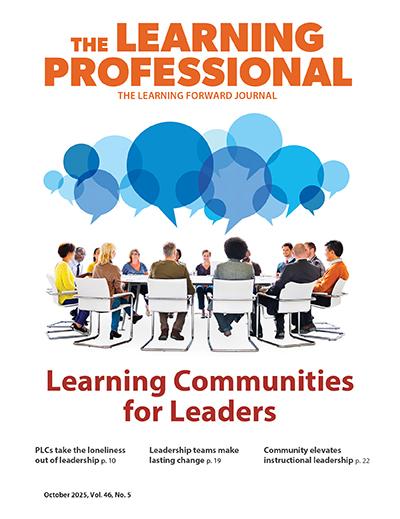
LEARNING COMMUNITIES FOR LEADERS
October 2025
Leaders need opportunities to connect, learn, and grow with peers just as...
