
4 Schools, 1 Goal
University-district partnership nets results for struggling readers
By Learning Forward
Categories: Coaching, Teacher leadershipJune 2014

Read the remaining content with membership access. Join or log in below to continue.
Sed ut perspiciatis unde omnis iste natus error sit voluptatem accusantium doloremque laudantium, totam rem aperiam, eaque ipsa quae ab illo inventore veritatis et quasi architecto beatae vitae dicta sunt explicabo. Nemo enim ipsam voluptatem quia voluptas sit aspernatur aut odit aut fugit, sed quia consequuntur magni dolores eos qui ratione voluptatem sequi nesciunt. Neque porro quisquam est, qui dolorem ipsum quia dolor sit amet, consectetur, adipisci velit, sed quia non numquam eius modi tempora incidunt ut labore et dolore magnam aliquam quaerat voluptatem.
9 Areas of Professional Learning
- Explicit instruction in comprehension strategies.
- Scaffolded instruction from direct instruction through independent practice.
- Standards-based grade-level expectations.
- Reading nonfiction and informational text.
- Monitoring with classroom data.
- Thinking and complexity above knowledge.
- Accountable independent reading.
- Data-informed instructional differentiation.
- Classroom environments with smooth routines.
Components of Professional Learning Sessions
- Generally, sessions included these components:
- Presentation of specific items for feedback.
- Class visits.
- Written and verbal peer feedback.
- Facilitated reflection on being observed, giving, and receiving feedback.
- New content/skill focus.
- Practice on a new focus.
- Job-alike group problem solving.
- School team planning.
- Reflection on the day’s learning and next steps.
References
Anderson, L.W. & Krathwohl, D.R. (Eds.). (2001). A taxonomy for learning, teaching, and assessing: A revision of Bloom’s Taxonomy of Educational Objectives. Boston, MA: Allyn & Bacon.
Gordon, W. & Oliva, P. (2012). Developing the curriculum (8th ed., pp. 149-150). Boston, MA: Pearson.
Hess, K.K., Carlock, D., Jones, B., & Walkup, J.R. (2009, June). What exactly do “fewer, clearer, and higher standards” really look like in classrooms? Using a cognitive rigor matrix to analyze curriculum, plan lessons, and implement assessments. Paper presented at CCSSO, Detroit, MI. Available at www.nciea.org/publication_PDFs/cognitiverigorpaper_KH12.pdf.
Lewis, K. & Hurd, J. (2011). Lesson study step by step. Portsmouth, NH: Heinemann.
Marzano, R.J. (2007). The art and science of teaching. Alexandria, VA: ASCD.
Marzano, R.J. (2006). Classroom assessment and grading that work. Alexandria, VA: ASCD.
Taylor, R.T. (2010). Leading learning: Change student achievement today! Thousand Oaks, CA: Corwin Press.
Learning Forward is the only professional association devoted exclusively to those who work in educator professional development. We help our members plan, implement, and measure high-quality professional learning so they can achieve success with their systems, schools, and students.
Categories: Coaching, Teacher leadership
CURRENT ISSUE
Recent Issues

APPLYING THE SCIENCE OF LEARNING
April 2026
Cognitive science illuminates how people learn. This issue shows how...

LEARNING WITH AI
February 2026
Generative AI can be a powerful tool for professional learning design and...

WHAT STUDENTS NEED NOW
December 2025
For all students to thrive, we need to understand who they are and what...
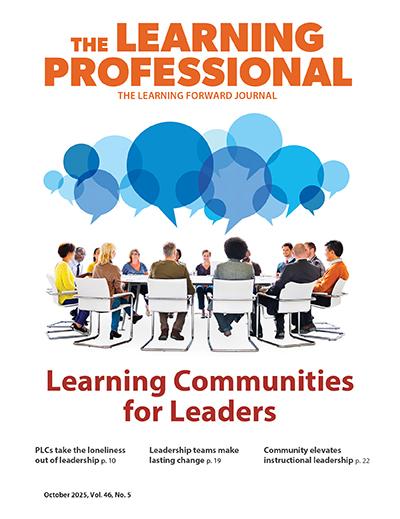
LEARNING COMMUNITIES FOR LEADERS
October 2025
Leaders need opportunities to connect, learn, and grow with peers just as...
