

Variations On A Theme
As needs change, new models of critical friends groups emerge
By Learning Forward
Categories: Learning communities, Learning designsAugust 2015

Read the remaining content with membership access. Join or log in below to continue.
Sed ut perspiciatis unde omnis iste natus error sit voluptatem accusantium doloremque laudantium, totam rem aperiam, eaque ipsa quae ab illo inventore veritatis et quasi architecto beatae vitae dicta sunt explicabo. Nemo enim ipsam voluptatem quia voluptas sit aspernatur aut odit aut fugit, sed quia consequuntur magni dolores eos qui ratione voluptatem sequi nesciunt. Neque porro quisquam est, qui dolorem ipsum quia dolor sit amet, consectetur, adipisci velit, sed quia non numquam eius modi tempora incidunt ut labore et dolore magnam aliquam quaerat voluptatem.
References
Breidenstein, A., Fahey, K., Glickman, C., & Hensley, F. (2012). Leading for powerful learning: A guide for instructional leaders. New York, NY: Teachers College Press.
Bryk, A.S., Sebring, P.B., Allensworth, E., Luppescu, S., & Easton, J.Q. (2010). Organizing schools for improvement: Lessons from Chicago. Chicago, IL: University of Chicago Press.
Fahey, K. (2007). Leadership learning: What happens after they get the license? Paper presented at the annual meeting of the American Educational Research Association, Chicago, IL.
Fahey, K. (2011). Still learning about leading: A leadership Critical Friends Group. Journal of Research on Leadership Education, 6(1), 1-35.
Fahey, K. & Ippolito, J. (2013). Learning about leading across the K-12 and higher education divide: The power of combining principal and university Critical Friends Groups. Paper presented at the annual meeting of the American Educational Research Association, San Francisco, CA.
Guskey, T.R. & Yoon, K.S. (2009). What works in professional development? Phi Delta Kappan, 90(7), 495-500.
Hargreaves, A. & Shirley, D. (2009). The persistence of presentism. Teachers College Record, 111(11), 2505-2534.
Ippolito, J. (2013). Professional learning as the key to linking content and literacy instruction. In J. Ippolito, J.F. Lawrence, & C. Zaller (Eds.), Adolescent literacy in the era of the Common Core: From research into practice (pp. 235-249). Cambridge, MA: Harvard Education Press.
Ippolito, J., Charner-Laird, M., & Dobbs, C. (2014, June). Bridge builders: Teacher leaders forge connections and bring coherence to literacy initiative. JSD, 35(3), 4.
McDonald, J.P., Mohr, N., Dichter, A., & McDonald, E.C. (2013). The power of protocols: An educator’s guide to better practice (3rd ed.). New York, NY: Teachers College Press.
Moore, J. (2012). Online teacher professional learning communities: Lessons learned from a virtual Critical Friends Group. Paper presented at the annual convention of the Association for Educational Communications and Technology, Louisville, KY.
National School Reform Faculty. (2012). NSRF self-guided tour of Critical Friends Groups. Bloomington, IN: Author.

Learning Forward is the only professional association devoted exclusively to those who work in educator professional development. We help our members plan, implement, and measure high-quality professional learning so they can achieve success with their systems, schools, and students.
Categories: Learning communities, Learning designs
CURRENT ISSUE

Recent Issues

APPLYING THE SCIENCE OF LEARNING
April 2026
Cognitive science illuminates how people learn. This issue shows how...

LEARNING WITH AI
February 2026
Generative AI can be a powerful tool for professional learning design and...

WHAT STUDENTS NEED NOW
December 2025
For all students to thrive, we need to understand who they are and what...
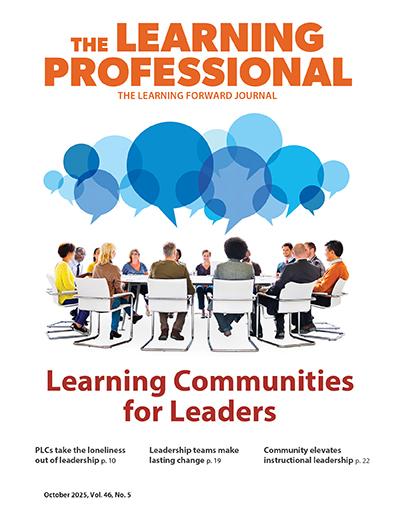
LEARNING COMMUNITIES FOR LEADERS
October 2025
Leaders need opportunities to connect, learn, and grow with peers just as...
