
Collaborative Culture
Ask questions, rather than dispense advice, to transform conversations into teachable moments
By Learning Forward
April 2013

Read the remaining content with membership access. Join or log in below to continue.
Sed ut perspiciatis unde omnis iste natus error sit voluptatem accusantium doloremque laudantium, totam rem aperiam, eaque ipsa quae ab illo inventore veritatis et quasi architecto beatae vitae dicta sunt explicabo. Nemo enim ipsam voluptatem quia voluptas sit aspernatur aut odit aut fugit, sed quia consequuntur magni dolores eos qui ratione voluptatem sequi nesciunt. Neque porro quisquam est, qui dolorem ipsum quia dolor sit amet, consectetur, adipisci velit, sed quia non numquam eius modi tempora incidunt ut labore et dolore magnam aliquam quaerat voluptatem.
Albert Einstein said, “We should take care not to make the intellect our god; it has, of course, powerful muscles, but no personality. It cannot lead. It can only serve.”
Why can’t the intellect lead? Because we make decisions first for emotional reasons, second for rational reasons. If someone attempts to engage our heads, but fails to engage our hearts as well, they will lose both.
We see this in business all the time. A brilliant new leader with good intentions and a great plan begins issuing directives. She eventually leaves because no one will follow her. Yes, she was smart, but we didn’t feel seen or valued by her. The messaging was all one way — from her to us.
This happens in organizations, families, and schools that cling to the old view of “I teach, you listen.” Social and emotional learning can change that, creating a passion for learning in students and adults.
— Susan Scott
References
Elias, M. (2008, March 5). Character development: The other side of the report card. [Web log post.] Available at www.edutopia.org/school-leaders-character-development.
Gladwell, M. (2008, December 15). Most likely to succeed. The New Yorker. Available online at www.newyorker.com/reporting/2008/12/15/081215fa_fact_gladwell.
Partnership for 21st Century Skills. (2011, March). Framework for 21st century learning. Available at www.p21.org/storage/documents/1.__p21_framework_2-pager.pdf.
Scales, P.C. & Leffert, N. (2004). Developmental assets: A synthesis of the scientific research on adolescent development. Minneapolis, MN: Search Institute.
Learning Forward is the only professional association devoted exclusively to those who work in educator professional development. We help our members plan, implement, and measure high-quality professional learning so they can achieve success with their systems, schools, and students.
CURRENT ISSUE
Recent Issues

APPLYING THE SCIENCE OF LEARNING
April 2026
Cognitive science illuminates how people learn. This issue shows how...

LEARNING WITH AI
February 2026
Generative AI can be a powerful tool for professional learning design and...

WHAT STUDENTS NEED NOW
December 2025
For all students to thrive, we need to understand who they are and what...
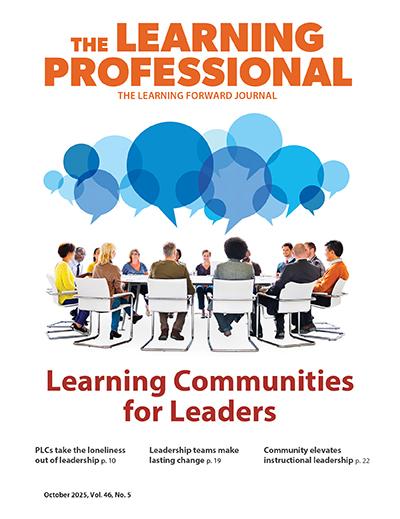
LEARNING COMMUNITIES FOR LEADERS
October 2025
Leaders need opportunities to connect, learn, and grow with peers just as...
