
All Aboard!
In one Iowa district, all teachers and principals are on the same journey
By Learning Forward
Categories: CollaborationApril 2013

Read the remaining content with membership access. Join or log in below to continue.
Sed ut perspiciatis unde omnis iste natus error sit voluptatem accusantium doloremque laudantium, totam rem aperiam, eaque ipsa quae ab illo inventore veritatis et quasi architecto beatae vitae dicta sunt explicabo. Nemo enim ipsam voluptatem quia voluptas sit aspernatur aut odit aut fugit, sed quia consequuntur magni dolores eos qui ratione voluptatem sequi nesciunt. Neque porro quisquam est, qui dolorem ipsum quia dolor sit amet, consectetur, adipisci velit, sed quia non numquam eius modi tempora incidunt ut labore et dolore magnam aliquam quaerat voluptatem.
Why Learning Teams Work
Factors that contribute to a shared sense of responsibility and fully functioning learning teams at Dallas Center-Grimes include:
- A clearly articulated focus about which practices teachers need to learn to improve student learning;
- A common vision that being student-focused is the district’s priority, and everybody is individually and collectively responsible for student achievement;
- The expectation that all staff will engage in professional learning and use their professional development time to accomplish student learning goals;
- Protected time built into the workday for collaboration; and
- Leadership demonstrated at every level of the organization.
Student Results
Scholastic Math Inventory
| 2011-12 Scholastic Math Inventory results | ||||
| Grade | Below proficiency | Advanced | ||
| 2011 | 2012 | 2011 | 2012 | |
| 6 | 31% | 9% | 12% | 27% |
| 7 | 19% | 15% | 9% | 15% |
| 8 | 27% | 11% | 8% | 11% |
Dallas Center-Grimes Community School District uses the Scholastic Math Inventory to assess all middle school students (grades 6-8) in math standards. This assessment aligns to the Iowa Common Core. In 2011-12, the percentage of students who scored below proficiency decreased, while the percentage of students ranked advanced increased in all three grades.
Iowa Assessments
| Percentage of students rated proficient in math on the Iowa Assessments | ||
| Grade | 2010 | 2012 |
| 7 | 90.4% | 92% |
| 8 | 88.5% | 93.9% |
| 9 | 84% | 91.3% |
| 10 | 81.9% | 89.4% |
On the Iowa Assessments, the number of students in grades 7-11 rated proficient in math increased from 2010 to 2012.
The percentage of students rated proficient in reading, science, and social studies on the Iowa Assessments at the secondary level also showed growth. In 2012, more than 90% of the students in grades 9-11 rated proficient in science and social studies and more than 87% in reading.
In 2012, more than 80% of students in grades 3-11 rated proficient in all subtests of the Iowa Assessments for the first time.
When the district first started using formative assessment practices in 2009, 7.5% of students were on Individualized Education Programs. By 2012, that number dropped to 6.6%. This is consistent with Dylan Wiliam and Paul Black’s (2010) assertion that formative assessment has the greatest impact on struggling learners.
Source: Iowa Testing Service.

References
Black, P. & Wiliam, D. (2010, September). Inside the black box: Raising standards through classroom assessment. Phi Delta Kappan, 92(1), 81-90.
Hirsh, S. (2009, Fall). A new definition. JSD, 30(4), 10-16.
Killion, J. & Roy, P. (2009). Becoming a learning school. Oxford, OH: NSDC.
Iowa Department of Education & Iowa Area Education Agencies. (2011). Exploring the Iowa core facilitator’s guide. Available at https://bit.ly/Wt7TgE.
National Staff Development Council. (2001). NSDC’s standards for staff development (revised). Oxford, OH: Author.
Popham, W.J. (2008). Transformative assessment. Alexandria, VA: ASCD.
Learning Forward is the only professional association devoted exclusively to those who work in educator professional development. We help our members plan, implement, and measure high-quality professional learning so they can achieve success with their systems, schools, and students.
Categories: Collaboration
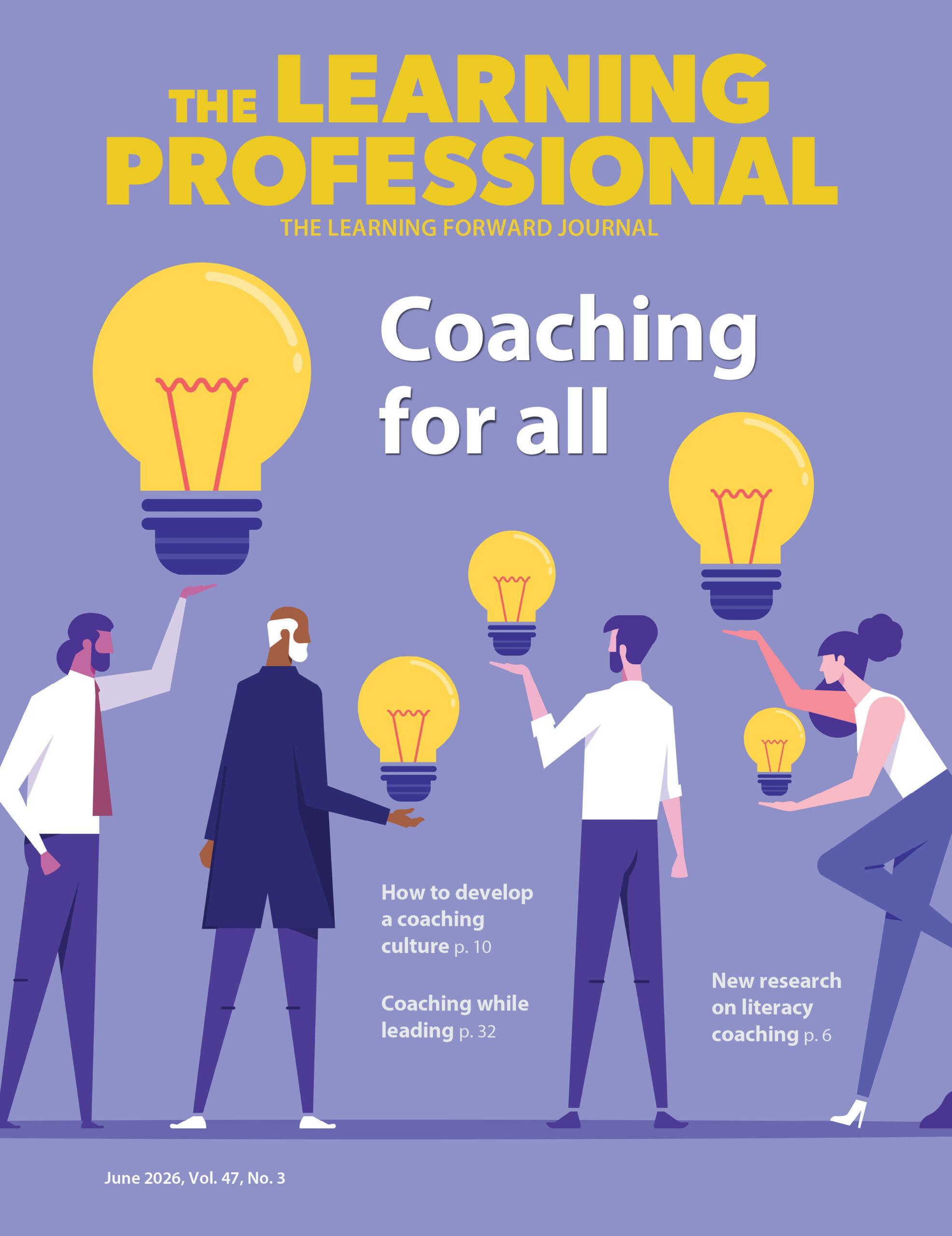
CURRENT ISSUE
Recent Issues

APPLYING THE SCIENCE OF LEARNING
April 2026
Cognitive science illuminates how people learn. This issue shows how...

LEARNING WITH AI
February 2026
Generative AI can be a powerful tool for professional learning design and...

WHAT STUDENTS NEED NOW
December 2025
For all students to thrive, we need to understand who they are and what...
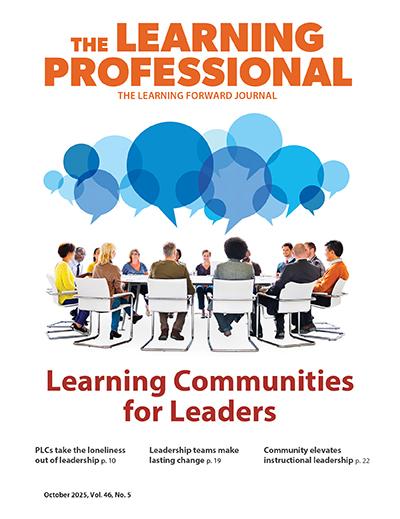
LEARNING COMMUNITIES FOR LEADERS
October 2025
Leaders need opportunities to connect, learn, and grow with peers just as...
