

Despite Rough Seas, Teachers In Rural Maine Swim Together
By Learning Forward
April 2011

Vol. 32 No. 2
Read the remaining content with membership access. Join or log in below to continue.
Sed ut perspiciatis unde omnis iste natus error sit voluptatem accusantium doloremque laudantium, totam rem aperiam, eaque ipsa quae ab illo inventore veritatis et quasi architecto beatae vitae dicta sunt explicabo. Nemo enim ipsam voluptatem quia voluptas sit aspernatur aut odit aut fugit, sed quia consequuntur magni dolores eos qui ratione voluptatem sequi nesciunt. Neque porro quisquam est, qui dolorem ipsum quia dolor sit amet, consectetur, adipisci velit, sed quia non numquam eius modi tempora incidunt ut labore et dolore magnam aliquam quaerat voluptatem.
The Leader's Role
For fellow leaders embarking in similar reform efforts, here are several suggestions for your learning journey:
- Plan to address the emotional aspects of change, and include in the plan a way for staff members’ emotions to be assessed and addressed.
- Be cognizant that teachers may experience what Reeves calls “initiative fatigue.” Help alleviate the fatigue by attempting to understand teachers’ individual needs and by clarifying and narrowing the focus for the professional learning.
- Be prepared to make and support structural changes within the school to sustain the reform, even though you may experience the “That is the way we have always done it” attitude.
- Do not attempt to do all the work alone. By increasing leadership capacity, you may let go of some of the work and move a staff closer to a shared vision by having more people understand and work towards the vision.
- Finally, be aware that many teachers will only trust you and commit to the reform when they see the benefit in the work for themselves or their students.

Dancing to Create Time for Learning
A team of primary grade teachers struggled to find common meeting time during the school day. At the same time, the librarian, music teacher, art teacher, and guidance counselor struggled to implement their respective curricula within the constraints of their weekly lessons.
The librarian proposed mixing the students by grades and teaching integrated lessons for a 45-minute period each week. The specialists would design and implement the integrated curricula lessons with the help of paraprofessionals.
Students experienced highly engaging lessons with a different group of peers and teacher each week. Meanwhile, classroom teachers met to address ways to support academically struggling students. This program became known as “Word Dance,” because the learning often centered on learning the vocabulary of the curricula as students created, sang, performed, and danced.
References
DuFour, R. (2004). What is a “professional learning community”? Educational Leadership, 61(8), 6-11.
DuFour, R., DuFour, R., Eaker, R., & Karhanek, G. (2004). Whatever it takes: How professional learning communities respond when kids don’t learn. Bloomington, IN: Solution Tree.
Elmore, R.F. (2002, May). Hard questions about practice. Educational Leadership, 59(8), 22‑25.
Kline, P. & Saunders, B. (1998). Ten steps to a learning organization. Arlington, VA: Great Ocean.
Reeves, D.B. (2010). Transforming professional development into student results. Alexandria, VA: ASCD.
Sarason, S.B. (1995). Some reactions to what we have learned. Phi Delta Kappan, 77(1), 84.
Schmoker, M. (2001). The results fieldbook: Practical strategies from dramatically improved schools. Alexandria, VA: ASCD.
Senge, P.M. (1990). The fifth discipline: The art and practice of the learning organization. New York: Doubleday.
Stiggins, R. (2001). Student-involved classroom assessment. Upper Saddle River, NJ: Prentice-Hall.
Tschannen-Moran, M., Uline, C., Hoy, A., & Mackley, T. (2000). Creating smarter schools through collaboration. Journal of Educational Administration, 38(3), 247-272.

Learning Forward is the only professional association devoted exclusively to those who work in educator professional development. We help our members plan, implement, and measure high-quality professional learning so they can achieve success with their systems, schools, and students.
CURRENT ISSUE

Recent Issues

APPLYING THE SCIENCE OF LEARNING
April 2026
Cognitive science illuminates how people learn. This issue shows how...

LEARNING WITH AI
February 2026
Generative AI can be a powerful tool for professional learning design and...

WHAT STUDENTS NEED NOW
December 2025
For all students to thrive, we need to understand who they are and what...
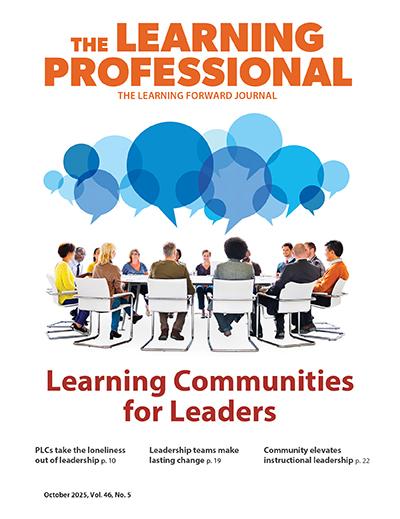
LEARNING COMMUNITIES FOR LEADERS
October 2025
Leaders need opportunities to connect, learn, and grow with peers just as...
